Monday, July 12, 2021

Sharon Solly

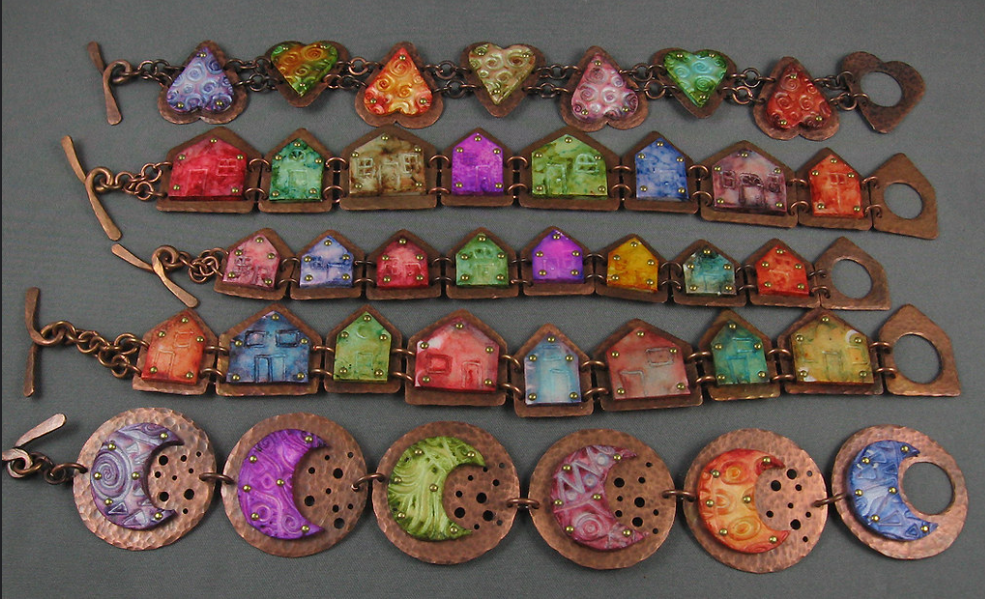
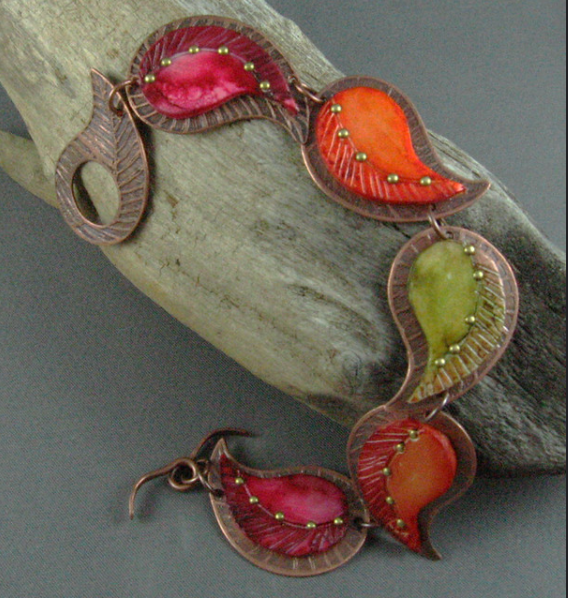
I was surfing through Pinterest this morning because I needed a break from grading. I ran across Sharon Solly's incredible polymer clay jewelry here: https://www.flickr.com/photos/sharonsolly/with/4377289466/

Isn't her work remarkable? Here are a few of my favorites:

These lampwork beads are made with a mix of clear and opaque polymer clay, not glass.


Cute earrings. Polymer clay formed into bars, then wrapped in copper.


I love this ring. Polymer "stone" and hammered copper band.


Another ring, made the same way.


Her copper etching is lovely!


Bracelets made of punched copper plates. Thin sheets of polymer designs are riveted to the sheets.


This is my very favorite piece. 


Tuesday, April 4, 2017

Thoughts about persistence

I absolutely love Tyler Knott Gregson's poetry, so I made a graphic out of one of my favorites. (Click on the image to enlarge it.) I blew it up to poster size, and now it hangs in my office to remind me to take a breath and re-focus.


Wednesday, June 1, 2016

I'm heading out to visit Mike and Saybel and the kids, so I've done some simple pieces for the granddarlings to decorate.  I used B-Mix with grog as the clay body, and I'll bisque them on Friday or Saturday.  I'm going to give the tumblers a coat of Pinnell slip, then cover them with a clear glaze.

[pics]

The kids can use sharpie oil paint pens to color their own cup, and then we'll bake the cups in the oven to set the paint.  If we do it according to the instructions (https://somethingturquoise.com/2015/01/13/diy-sharpie-mug-engagement-gift/), the paint should be permanent.


I did a few birds so that I could have a present for Gina's birthday, as well as something fun to try my gelli print decals on.  I also saw a cute wind chime on Pinterest that I copied for the kids to paint for Mike for Father's Day.  I'm hoping to hike around with them and find a stick to use as a frame to hang the pieces on.

[pic]

So far, I've made do with simple Laguna cone 6 glazes, but I really want to start mixing my own glazes again.  I decided to start with some basic mid-range glazes from http://ceramicartsdaily.org/wp-content/uploads/2014/01/15Cone6-GlazeRecipesNEW1.pdf

I'm starting with this one, because I have the components on hand already:

N502 Transparent and Glossy
Cone 5

  • Gillespie Borate . . . . . . . . . . . . . . . . . 30 %
  • F-4 Feldspar . . . . . . . . . . . . . . . . . . . . 46.
  • EPK Kaolin . . . . . . . . . . . . . . . . . . . . . 13
  • Silica . . . . . . . . . . . . . . . . . . . . . . . . . 11
  • 100%


I'm going to have to use gerstly borate and the feldspar I already have.  I'll start with direct substitutions and make corrections as I go along.  I really like the idea of being able to add colorants as desired.  Here are the test results from CAD:


Next on the shopping list: copper carbonate and strontium carbonate.

I plan to try the firing schedule from CAD: http://ceramicartsdaily.org/free-gifts/electric-kiln-firing-techniques-and-tips-inspiration-instruction-and-glaze-recipes-for-electric-ceramic-kilns/

1st segment – 50°F/hour to 220°F
2nd segment – 250°F/hour to 2167°F
3rd segment – cool down 150°F/hour to 1500°F

I'm looking forward to seeing the results.

Thursday, October 22, 2015

I hate to admit, even to myself, the extent of my Pinterest habit.  Suffice it to say that I spend too much time reading about ceramics instead of playing with clay.  On the other hand, sometimes I find something I just have to do.

I've read this article at least a dozen times over the last year or so, because it keeps popping up in my Pinterest list.  http://finemessblog.blogspot.com/2014/07/that-one-image-transfer-technique.html.  It talks about the benefits of using a laser printer, because water beads up on the ink and soaks into the paper around it.

This may seem like an irrelevancy, but it's not.  You see, it is possible to make a thin wash of colorants and brush them lightly over the design in a laser print.  The colorant soaks into the paper and doesn't stick to the ink.  Voila!  Instant transfers!

Excerpts from the blog:

Here's what you need:
  1. A laser print. Not a photocopy, not an inkjet print. Make it stark black & white - no gray tones
  2. Slightly thin underglaze or slip. The thinner it is, the better it will roll away from the toner as, but also the fainter the design will be. This will take some monkeying around with, to get it right.
  3. A soft brush. Very soft. A stiffer brush seems to press the slip to the paper too hard.
  4. An early-leatherhard piece. 
  5. A rubber rib, the really bendy kind
  6. A throwing sponge
  7. A spritz bottle of water. Very important! Release will be blotchy without it. 

Here's what you do:
  1. Brush your slip or underglaze onto the printed side of teh paper. One coat only; once the paper is wet, the resist doesn't work as well. Watch the slip roll away from the black areas. If a few spots are recalcitrant, you can blow on them really hard to encourage the slip to move. If the resist doesn't happen, your slip may be too thick.
  2. Let the slip get bone-dry.
  3. Cut into the shape of the print you want to make.
  4. Spritz the surface of the piece so there's a thin sheen of water. Place the paper facedown on the wet surface
  5. Spritz the back of the paper. Press repeatedly with a wet sponge. You'll begin to see the image showing through the paper. If there are areas where the image doesn't show, press the we sponge in those spots until it does.
  6. Using the rubber rib, smooth the paper to the clay to encourage the transfer. 
  7. Peel up the paper. Voilet! or whatever. Image transferred. Mine is still a little blotchy - I'll clean it up with a sgraffito tool later. I think with some practice I can get a cleaner image. 

I tried it with a beautiful design I printed on the library's printer.  The black wasn't truly black, more of a darkish grey.  And maybe my slip was too thick, too.  Whatever the reason, it didn't work very well.  I found myself blowing on the black parts until I was lightheaded, and still too much was unusable.

I read somewhere that mixing equal amounts of Mason stain and a frit can yield good results with beautiful colors.  So here's what I decided to try tonight:

1.  A design with the exposure set fairly dark

2.  1 Tbsp. stain, 1Tbsp. frit, 1 cup water

3.  Flat shapes cut from B-mix without grog, so the surface is almost buttery

As Dr. Seuss said in The Butter Battle Book, "We shall see.  We shall see..."

Friday, October 16, 2015

I wanted to make some colored slip to use on my gelli plates, and here is the recipe that I used:

1/2 cup Pinnell White Slip
1 heaping Tablespoon Mason stain
1 1/2 Tablespoon Karo syrup  (helps the stain stick to the paper)
1/2 to 3/4 cup water

I was having problems getting the slip to stick to the newsprint, so I added Karo.  Now it sticks very well, but I can't do multiple layers because it also sticks to the next layer's stencil.  So I've been doing only single-layer prints, and I'll combine them on the clay.

I'm using encapsulated stains on cone 10 clay.  We'll see what happens when this stuff gets fired.


Here's the slip recipe:


Source: http://www.nxtbook.com/nxtbooks/claytimes/2011spring/index.php?startid=21


I've also seen it called "Pete Pinnell's Forgiving White Slip," which seems pretty accurate for something that fires in such a wide range.  But if you read the article, Kona F-4 "begins to actively melt at mid-range temperatures (cone 5-7)."  Maybe that's why it has worked for me the few times I've used it.  Until now, I've been throwing work into studio cone 10 firings, and the Kona is completely melted at that point.

Note:  Mix to a thick glaze consistency.  It defloccuates overnight, so wait until the next day to add additional water.  I didn't add any extra water to it before using it for my gelli slip recipe.

Just so I have it later, here is his low-fire version:

Pete Pinnell's White Slip (low-fire)
40 OM4
40 Talc
10 Silica
10 Nepheline Syenite
-------------------------
100

+10 Frit 3124
+7 Zircopax

(You can also add a few drops of sodium silicate - a deflocculant that helps reduce viscosity and makes the slip easier to apply with a slip bottle.)

Source:  http://www.meaganchaneygumpert.com/BlogRetrieve.aspx?PostID=325621&A=SearchResult&SearchID=3714699&ObjectID=325621&ObjectType=55#.ViE3-flVhBc
Gelli prints are making a comeback, and I've hopped on the bandwagon.  They were a popular way of printing in the fifties and sixties, before mimeograph machines made small-batch printing possible.

They're very easy to do:


*Her "stronger recipe" calls for glycerin.  I had a bottle in the laundry closet, but it was only half as much as she called for.  It worked just fine.


I want to try this method:


This woman's recipe:

7 packets of plain gelatin
1/2 cup glycerine
1 cup rubbing alcohol
1 1/2 cup boiling water

It's basically Linda Germain's recipe with a cup of rubbing alcohol added.  My plates are getting a little dry, so I think I'll remelt them in the microwave and add some alcohol and see what happens.  :)


Thursday, April 26, 2012

Island Crackle

Island  Crackle   T5                          Island Crackle T5
Code Number:                                  Code Number:
=========================================     =========================================
                                              
  G-200 Feldspar..............    37.00         G-200 Feldspar..............   184.98
  Whiting.....................    16.40         Whiting.....................    81.99
  Grolleg Kaolin..............    14.74         Grolleg Kaolin..............    73.72
  Silica......................    31.86         Silica......................   159.30
 =Add: FeO....................     0.50        =FeO.........................     2.50
                              =========                                     =========
                                 100.50                                        502.50
                                              
          CaO       0.72*   10.40   11.95               CaO       0.72*   10.40   11.95
          MgO       0.01*    0.07    0.11               MgO       0.01*    0.07    0.11
          K2O       0.19*    4.67    3.19               K2O       0.19*    4.67    3.19
          Na2O      0.08*    1.25    1.30               Na2O      0.08*    1.25    1.30
          TiO2      0.00     0.00    0.00               TiO2      0.00     0.00    0.00
          Al2O3     0.51    13.46    8.50               Al2O3     0.51    13.46    8.50
          SiO2      4.50    69.46   74.46               SiO2      4.50    69.46   74.46
          Fe2O3     0.00     0.15    0.06               Fe2O3     0.00     0.15    0.06
          FeO       0.03     0.55    0.43               FeO       0.03     0.55    0.43
                                              
                        Cost:    0.04                                 Cost:    0.04
              Calculated LOI:    8.98                       Calculated LOI:    8.98
                 Imposed LOI:                                  Imposed LOI:
                       Si:Al:    8.76                                Si:Al:    8.76
                      SiB:Al:    8.76                               SiB:Al:    8.76
           Thermal Expansion:    6.87                    Thermal Expansion:    6.87
              Formula Weight:  389.38                       Formula Weight:  389.38
                                              
                                              
                 Recipe Date: 2012-04-26                       Recipe Date: 2012-04-26
                Today's Date: 4/26/2012                       Today's Date: 4/26/2012 
 
Note: Based on M12 G-200 + 10g SiO 

Penzance Blue

Penzance Blue T5                              Penzance Blue   T5
Code Number:                                  Code Number:
=========================================     =========================================
                                              
  Cornwall Stone..............    62.28         Cornwall Stone..............   311.42
  Whiting.....................    17.85         Whiting.....................    89.24
  Grolleg Kaolin..............    14.83         Grolleg Kaolin..............    74.14
  Silica......................     5.04         Silica......................    25.19
 =Add: FeO....................     0.50        =FeO.........................     2.50
                              =========                                     =========
                                 100.50                                        502.50
                                              
          CaO       0.75*   12.52   14.56               CaO       0.75*   12.52   14.56
          MgO       0.00*    0.05    0.08               MgO       0.00*    0.05    0.08
          K2O       0.11*    3.05    2.11               K2O       0.11*    3.05    2.11
          Na2O      0.13*    2.41    2.54               Na2O      0.13*    2.41    2.54
          P2O5      0.01*    0.34    0.16               P2O5      0.01*    0.34    0.16
          TiO2      0.00     0.07    0.06               TiO2      0.00     0.07    0.06
          Al2O3     0.57    17.37   11.11               Al2O3     0.57    17.37   11.11
          SiO2      3.54    63.42   68.85               SiO2      3.54    63.42   68.85
          Fe2O3     0.00     0.22    0.09               Fe2O3     0.00     0.22    0.09
          FeO       0.02     0.56    0.44               FeO       0.02     0.56    0.44
                                              
                        Cost:    0.04                                 Cost:    0.04
              Calculated LOI:   10.50                       Calculated LOI:   10.50
                 Imposed LOI:                                  Imposed LOI:
                       Si:Al:    6.20                                Si:Al:    6.20
                      SiB:Al:    6.20                               SiB:Al:    6.20
           Thermal Expansion:    7.15                    Thermal Expansion:    7.15
              Formula Weight:  335.63                       Formula Weight:  335.63
                                              
                                              
                 Recipe Date: 2012-04-26                       Recipe Date: 2012-04-26
                Today's Date: 4/26/2012                       Today's Date: 4/26/2012
 
Note: Based on G18 Cornwall 

Calypso White

Calypso White   T5                            Calypso White   T5
Code Number:                                  Code Number:
=========================================     =========================================
                                              
  Nepheline Syenite...........    32.65         Nepheline Syenite...........   163.25
  Talc........................    26.54         Talc........................   132.70
  Grolleg Kaolin..............    25.77         Grolleg Kaolin..............   128.85
  Silica......................    15.04         Silica......................    75.20
 =Add: FeO....................     0.50        =FeO.........................     2.50
                              =========                                     =========
                                 100.50                                        502.50
                                              
          CaO       0.11*    1.94    2.18               CaO       0.11*    1.94    2.18
          MgO       0.64*    7.90   12.37               MgO       0.64*    7.90   12.37
          K2O       0.07*    2.09    1.40               K2O       0.07*    2.09    1.40
          Na2O      0.18*    3.38    3.44               Na2O      0.18*    3.38    3.44
          TiO2      0.00     0.01    0.01               TiO2      0.00     0.01    0.01
          Al2O3     0.59    18.46   11.41               Al2O3     0.59    18.46   11.41
          SiO2      3.55    65.48   68.71               SiO2      3.55    65.48   68.71
          Fe2O3     0.00     0.22    0.09               Fe2O3     0.00     0.22    0.09
          FeO       0.02     0.52    0.40               FeO       0.02     0.52    0.40
                                              
                        Cost:                                         Cost:
              Calculated LOI:    4.56                       Calculated LOI:    4.56
                 Imposed LOI:                                  Imposed LOI:
                       Si:Al:    6.02                                Si:Al:    6.02
                      SiB:Al:    6.02                               SiB:Al:    6.02
           Thermal Expansion:    5.98                    Thermal Expansion:    5.98
              Formula Weight:  325.39                       Formula Weight:  325.39
                                              
                                              
                 Recipe Date: 2012-04-26                       Recipe Date: 2012-04-26
                Today's Date: 4/26/2012                       Today's Date: 4/26/2012
 
Note: good liner glaze 

Calypso Blue

Calypso   T5                                  Calypso   T5
Code Number:                                  Code Number:
=========================================     =========================================
                                              
  Nepheline Syenite...........    32.19         Nepheline Syenite...........    32.19
  Whiting.....................    18.24         Whiting.....................    18.24
  Grolleg Kaolin..............    22.60         Grolleg Kaolin..............    22.60
  Silica......................    26.97         Silica......................    26.97
 =Add: FeO....................     0.50        =FeO.........................     2.50
                              =========                                     =========
                                 100.50                                        102.50
                                              
          CaO       0.72*   11.68   13.53               CaO       0.72*   11.42   13.30
          MgO       0.01*    0.11    0.18               MgO       0.01*    0.11    0.18
          K2O       0.08*    2.14    1.48               K2O       0.08*    2.09    1.45
          Na2O      0.20*    3.56    3.73               Na2O      0.20*    3.48    3.67
          TiO2      0.00     0.01    0.01               TiO2      0.00     0.01    0.01
          Al2O3     0.60    17.71   11.29               Al2O3     0.60    17.32   11.09
          SiO2      3.66    64.02   69.25               SiO2      3.66    62.63   68.05
          Fe2O3     0.00     0.21    0.09               Fe2O3     0.00     0.21    0.08
          FeO       0.02     0.56    0.44               FeO       0.12     2.72    2.18
                                              
                        Cost:    0.05                                 Cost:    0.04
              Calculated LOI:   10.70                       Calculated LOI:   10.49
                 Imposed LOI:                                  Imposed LOI:
                       Si:Al:    6.14                                Si:Al:    6.14
                      SiB:Al:    6.14                               SiB:Al:    6.14
           Thermal Expansion:    7.20                    Thermal Expansion:    7.04
              Formula Weight:  343.53                       Formula Weight:  351.19
                                              
                                              
                 Recipe Date: 2012-04-26                       Recipe Date: 2012-04-26
                Today's Date: 4/26/2012                       Today's Date: 4/26/2012

Calypso Clear

Calypso Clear   T5                            Confederate Blue   T5
Code Number:                                  Code Number:
=========================================     =========================================
                                              
  Nepheline Syenite...........    33.76         Nepheline Syenite...........   168.80
  Whiting.....................    19.14         Whiting.....................    95.70
  Grolleg Kaolin..............    23.71         Grolleg Kaolin..............   118.55
  Silica......................    23.39         Silica......................   116.95
                              =========                                     =========
                                 100.00                                        500.00
                                              
          CaO       0.72*   12.40   14.41               CaO       0.72*   12.40   14.41
          MgO       0.01*    0.12    0.19               MgO       0.01*    0.12    0.19
          K2O       0.08*    2.27    1.57               K2O       0.08*    2.27    1.57
          Na2O      0.20*    3.78    3.98               Na2O      0.20*    3.78    3.98
          TiO2      0.00     0.01    0.01               TiO2      0.00     0.01    0.01
          Al2O3     0.60    18.79   12.02               Al2O3     0.60    18.79   12.02
          SiO2      3.36    62.41   67.73               SiO2      3.36    62.41   67.73
          Fe2O3     0.00     0.23    0.09               Fe2O3     0.00     0.23    0.09
                                              
                        Cost:    0.05                                 Cost:    0.05
              Calculated LOI:   11.28                       Calculated LOI:   11.28
                 Imposed LOI:                                  Imposed LOI:
                       Si:Al:    5.64                                Si:Al:    5.64
                      SiB:Al:    5.64                               SiB:Al:    5.64
           Thermal Expansion:    7.45                    Thermal Expansion:    7.45
              Formula Weight:  323.67                       Formula Weight:  323.67
                                              
                                              
                 Recipe Date: 2012-04-26                       Recipe Date: 2012-04-26
                Today's Date: 4/26/2012                       Today's Date: 4/26/2012

Confederate Blue


Confederate Blue   T5                         Confederate Blue   T5
Code Number:                                  Code Number:
=========================================     =========================================
                                              
  Custer Feldspar.............    45.05         Custer Feldspar.............   225.25
  Whiting.....................    19.31         Whiting.....................    96.53
  Grolleg Kaolin..............    23.93         Grolleg Kaolin..............   119.65
  Silica......................    11.71         Silica......................    58.56
 =Add: FeO....................     0.50        =FeO.........................     2.50
                              =========                                     =========
                                 100.50                                        502.50
                                              
          CaO       0.72*   12.33   14.54               CaO       0.72*   12.33   14.54
          MgO       0.01*    0.08    0.13               MgO       0.01*    0.08    0.13
          K2O       0.20*    5.71    4.01               K2O       0.20*    5.71    4.01
          Na2O      0.08*    1.50    1.60               Na2O      0.08*    1.50    1.60
          TiO2      0.00     0.01    0.01               TiO2      0.00     0.01    0.01
          Al2O3     0.60    18.69   12.12               Al2O3     0.60    18.69   12.12
          SiO2      3.31    60.88   67.03               SiO2      3.31    60.88   67.03
          Fe2O3     0.01     0.25    0.10               Fe2O3     0.01     0.25    0.10
          FeO       0.02     0.56    0.45               FeO       0.02     0.56    0.45
                                              
                        Cost:    0.23                                 Cost:    0.23
              Calculated LOI:   11.31                       Calculated LOI:   11.31
                 Imposed LOI:                                  Imposed LOI:
                       Si:Al:    5.53                                Si:Al:    5.53
                      SiB:Al:    5.53                               SiB:Al:    5.53
           Thermal Expansion:    7.64                    Thermal Expansion:    7.64
              Formula Weight:  326.26                       Formula Weight:  326.26
                                              
                                              
                 Recipe Date: 2012-04-26                       Recipe Date: 2012-04-26
                Today's Date: 4/26/2012                       Today's Date: 4/26/2012
 
Note: based on M12 Custer 

Tuesday, April 24, 2012

Test 4

Latest Recipes

M12 + NephSy + .5 FeO
Code Number: 
=========================================

  Nepheline Syenite...........    27.68  
  Silica......................    31.60  
  Grolleg Kaolin..............    30.90  
  Whiting.....................     4.70  
  MgO.........................     5.12  
 =FeO.........................     0.50  
                              =========
                                 100.50
 
-----------
 
Wollive Mint - Test 4
Code Number: 
=========================================

  Wollastonite................    17.63  
  Silica......................    29.33  
  Soda Ash....................     4.18  
  Tile #6 Kaolin..............    43.56  
  MgO.........................     5.29  
 =FeO.........................     0.50  
                              =========
                                 100.50
 
------------------
 
Cornwall/Brighton Test 4
Code Number: 
=========================================

  Cornwall Stone..............    50.11  
  Whiting.....................     6.62  
  Silica......................    12.42  
  MgO.........................     7.03  
  Grolleg Kaolin..............    23.82  
 =FeO.........................     0.50  
                              =========
                                 100.50
 
---------------------------
 
G-200/Smokey Blue  - Test 4
Code Number: 
=========================================

  G-200 Feldspar..............    13.22  
  Whiting.....................    15.38  
  Silica......................    30.05  
  Grolleg Kaolin..............    36.45  
  MgO.........................     4.90  
 =FeO.........................     0.50  
                              =========
                                 100.50 

Wednesday, April 18, 2012

Third test's the charm

I loved the second set of test tiles, but all of my glazes crazed because the thermal expansion factors didn't match my clay.  So I took my favorite ones and reformulated them to match my porcelain, with a thermal expansion factor of 5.94.

M12 with NephSy and .5 FeO turned out to be the color of the water around Grand Cayman Island, so I named it "Calypso Blue."   I hear steel drums playing whenever I see it.  This glaze ran all over (duh!) and crazed.  I wanted to add MgO to reduce the crazing but didn't want to increase the amount of flux in such a runny glaze, so I swapped talc for whiting, which substituted MgO (TE rate of .026) for CaO (TE rate of .148).

  Calypso Blue


  Nepheline Syenite...........    32.65  
  Silica......................    15.04  
  Grolleg Kaolin..............    25.77  
  Talc........................    26.54  
  Add: FeO....................     5.77  
                              =========
                                 105.77

I had to rename my Frankenstein K glaze, because after reformulation it no longer had any potassium (or sodium, for that matter).  I'm curious to see how this one turns out.  Rebecca was appalled that it had real bone ash in it (as opposed to a mystery clay with that name?), so we named it "Donner Yellow."  I hope it retains its bright yellow color.  I switched the clay in it from Grolleg to Tile 6 in hopes that the titanium would enhance the yellow and make it less speckly and odd.  We'll see.


  Donner Yellow


  Tile #6 Kaolin..............    29.97  
  Silica......................    26.38  
  bone ash....................    40.68  
  Talc........................     2.97  
  Add: FeO....................     0.50  
 
                              =========
                                 100.50

G18 with wollastonite was beautiful, but only in the version with .5 FeO.  The version without colorant was washed out and unattractive, but with the iron it turned a lovely light green.  It's a little too olive for my taste, so I decided to substitute Tile 6 for the Grolleg to see if I could get a nice mint green.  I'll still use the Grolleg version, though, because it is beautiful.  It also ended up with an intriguing black line at the edge of the glaze, which I hope to be able to duplicate.  I really need to think up better titles for these!

  Wollive Green


  Wollastonite................    16.76  
  Whiting.....................     5.59  
  Silica......................    34.79  
  Grolleg Kaolin..............    36.20  
  Soda Ash....................     6.67  
  Add: FeO....................     0.50  
                              =========
                                 100.51

  Wollive Mint


  Wollastonite................     8.80  
  Whiting.....................     5.56  
  Silica......................    35.86  
  Soda Ash....................     3.50  
  Tile #6 Kaolin..............    46.28  
  Add: FeO....................     0.50  
                              =========
                                 100.50

G18 Frankenstein Na with .5 FeO turned out to be a beautiful, robin's-egg blue, complete with speckles from un-ballmilled iron particles.  Even though it shouldn't fit, it seemed to do just fine, so I'm going to keep the recipe as is for now.


  Frankenstein Na

  Soda Ash....................     6.65  
  Whiting.....................    18.53  
  Grolleg Kaolin..............    36.55  
  Silica......................    38.27  
  Add: FeO....................     0.50  
                              =========
                                 100.50

In Celadon Blues, Robert Tichane mentions that he hopes that someone will use Cornwall stone as part of their celadon recipe.  I know that I am but the latest neophyte to follow his instruction, but I have to say that he is absolutely right.  I really love the light blue that resulted from the trace amounts of iron in the Cornwall stone.  It was also beautiful with .5 FeO.  It crackled heavily, though, so I added a large amount of MgO from talc to substitute for most of the CaO.  Because both the Cornwall and Grolleg are from England, Rebecca and I decided to name this one "Brighton Blue."


  Brighton Blue


  Cornwall Stone..............    25.19  
  Whiting.....................    13.27  
  Silica......................    14.50  
  Grolleg Kaolin..............    32.82  
  Talc........................    14.21  
  Add: FeO....................     0.50  
                              =========
                                 100.50

I was surprised at the color from G18 with G-200 and .5 FeO.  It almost looks like I added cobalt instead, kind of a smoky blue.  It also crackled heavily, so I used dolomite to substitute MgO for CaO to lower the thermal expansion rate.


  Smokey Blue


  G-200 Feldspar..............    28.64 
  Whiting.....................     1.38  
  Silica......................    28.08  
  Grolleg Kaolin..............    37.53  
  Dolomite....................     4.37  
  Add: FeO....................     0.50  
                              =========
                                 100.50

For a project that started out to be a complete wash-out, I'm absolutely thrilled by the results I'm getting.  These six glazes (seven if you count both wollastonite ones) produce a range of beautiful pastels from greens to yellows.  Kind of cool when you figure that I never used any colorant besides .5 FeO.

Thursday, March 15, 2012

Clays

Todd keeps asking me if I have checked my clay recipes in Insight to see if the thermal expansion rates match my glazes.  I finally remembered to write them down.

Grolleg Porcelain:


  Grolleg Kaolin..............    51.50  
  Custer Feldspar.............    28.00  
  Flint.......................    18.50  
  Hectalite 200...............     2.00  
                              =========
                                 100.00
  *Thermal expansion: 5.94


Dan's Four Equal Parts White Stoneware:
  Tile #6 Kaolin..............    25.00  
  Hawthorne ..................    25.00  
  Custer Feldspar.............    25.00  
  Flint.......................    25.00  
                              =========
                                 100.00
  *Thermal expansion: 5.52

Revised test recipes

It turns out that when you sit in your office high in the ivory tower and calculate recipes, you run the risk of using ingredients that aren't actually available in the lab.  When I looked for available feldspars, there are only five that we have in stock: Custer, Kona F-4, G-200, Cornish stone, and Nepheline syenite.  The last two aren't really feldspars, but they are close enough chemically that I am including them as potentially wonderful possibilities.

After talking with Dan and Todd, I am also going to try wollastonite and spodumene.  Cait also suggested eliminating spars altogether and making my own Frankensteinian mix using silica, alumina, soda ash, and potassium carbonate.

So here are the recipes I will be testing to check the effects potassium and sodium have on color and surface.  For the feldspars, I was able to swap them out and match the Seger formulas precisely.  For the others, I got as close to the Segers as I could, but it was difficult to match the fluxes (for example, spodumene has minute amounts of lithium, not present in Custer).


MATTE GLAZE 12

  Custer Feldspar........    45.50  
  Whiting................    19.50  
  Grolleg Kaolin.........    24.17  
  Silica.................    10.83  
  Add: FeO...............     0.50  
                          =========
                            100.50 
 
 
     Nepheline Syenite......    34.44  
     Whiting................    19.52  
     Grolleg Kaolin.........    24.18  
     Silica.................    21.86  
     Add: FeO...............     0.50  
                             =========
                               100.50
 
 
  G-200 Feldspar.........    44.02  
  Whiting................    19.62  
  Grolleg Kaolin.........    24.18  
  Silica.................    12.18  
  Add: FeO...............     0.50  
                          =========
                            100.50


     Wollastonite Vansil....    10.53  
     Grolleg Kaolin.........    43.90  
     Silica.................    26.95    
     Soda Ash...............     6.94  
     Calcium Carbonate......    11.18
     Add: FeO...............     0.50  
                             =========
100.00
 
 
  Kona F-4 Feldspar......    44.59  
  Whiting................    18.66  
  Grolleg Kaolin.........    23.13  
  Silica.................    13.62  
  Add: FeO...............     0.50  
                          =========
                            100.50


     Spodumene..............     5.38  
     Whiting................    17.51  
     Grolleg Kaolin.........     5.38  
     Silica.................    45.04  
     Alumina Hydrate........    19.17  
     Soda Ash...............     7.51  
     Add: FeO...............     0.50  
                             =========
                               100.50
 
 
  DF Cornwall Stone......    36.62  
  Whiting................    19.73  
  Grolleg Kaolin.........    22.78  
  Silica.................     3.47  
  Nepheline Syenite......    17.39  
  Add: FeO...............     0.50  
                          =========
                            100.50


   Frankenstein K:

     Bone Ash...............     5.41  
     Whiting................    13.21  
     Grolleg Kaolin.........    45.22  
     Silica.................    29.40  
     Soda Ash...............     2.25  
     Talc...................     4.51  
     Add: FeO...............     0.50  
                             =========
                               100.50
 
Frankenstein Na:  

  Whiting................    18.80  
  Grolleg Kaolin.........    43.71  
  Silica.................    30.76  
  Soda Ash...............     6.73  
  Add: FeO...............     0.50  
                          =========
                            100.50


GLOSS GLAZE 18

  Custer Feldspar........    42.88  
  Whiting................    18.38  
  Grolleg Kaolin.........    16.25  
  Silica.................    22.50  
  Add: FeO...............     0.50  
                          =========
                            100.50
 
 
     Nepheline Syenite......    32.01  
     Whiting................    18.45  
     Grolleg Kaolin.........    16.31  
     Silica.................    33.23  
     Add: FeO...............     0.50  
                             =========
                               100.50
 
 
  G-200 Feldspar.........    40.70  
  Whiting................    18.04  
  Grolleg Kaolin.........    16.22  
  Silica.................    25.05  
  Add: FeO...............     0.50  
                          =========
                            100.50
 
 
     Wollastonite Vansil....    16.76  
     Whiting................     5.59  
     Grolleg Kaolin.........    36.20  
     Silica.................    34.79  
     Soda Ash...............     6.67  
     Add: FeO...............     0.50  
                             =========
100.50
 
  F-4 Feldspar...........    41.27  
  Whiting................    17.69  
  Grolleg Kaolin.........    15.16  
  Silica.................    25.89  
  Add: FeO...............     0.50  
                          =========
                            100.50


     Spodumene..............     5.88  
     Whiting................     8.19  
     Grolleg Kaolin.........    32.81  
     Silica.................    40.59  
     Bone Ash...............    10.66  
     Talc...................     1.86  
     Add: FeO...............     0.50  
                             =========
                               100.50
 
  DF Cornwall Stone......    64.77  
  Whiting................    18.56  
  Grolleg Kaolin.........    15.42  
  Silica.................     1.24  
  Add: FeO...............     0.50  
                          =========
                            100.50
  Frankenstein K:

     Grolleg Kaolin.........    37.35  
     Silica.................    43.51  
     Bone Ash...............    19.14  
     Add: FeO...............     0.50  
                             =========
                               100.50

Frankenstein Na:

  Soda Ash...............     6.65  
  Whiting................    18.53  
  Grolleg Kaolin.........    36.55  
  Silica.................    38.27  
  Add: FeO...............     0.50  
                          =========
                            100.50
     

Monday, March 5, 2012

Custer and Kona tests

I pulled some gorgeous test tiles out of the kiln on Friday, the results of my first tests on Custer and Kona F-4 feldspars.  These are the glazes that I wanted to find by the end of the semester, so I'm beyond psyched.  I know that this project throws me squarely in the middle of the Pastel Porcelain Crowd, but I have no problems with that, or with producing functional pieces.  Hey, I'm actually thrilled when a piece is truly functional; my skills are still fairly rudimentary. 

I really, really love these glazes!  I've been testing my buttery Matte 12 base glaze on three kinds of clay: grolleg porcelain, white stoneware (Dan's Four Equal Parts), and regular stoneware.  The porcelain is the purest I could manage, so there is only a minute amount of iron in it to color the glaze.  Even at that, the base glaze comes out slightly blue.  The white stoneware has a tiny amount of iron, but it makes the blue a little greyish.  The regular stoneware, of course, has enough iron to completely change the glaze color and ends up being a fairly bland, nasty grey.

Matte 12 base with Custer feldspar, no added FeO, on three clays.


Here is the same base recipe, with Kona F-4 feldspar on the same clays:

Matte 12 with Kona F-4 on grolleg porcelain, white stoneware, and regular stoneware

I wanted to see what a half-percent of black iron oxide would do, and the results were pretty spectacular:

Matte 12 with Custer feldspar and .5% FeO on grolleg porcelain, white stoneware, and regular stoneware

The speckling is considered a fault, but I think it will work well for some applications.  It especially looks good on the stoneware because it mimics the clays natural mottled appearance.  For porcelain, I will need to ball-mill the glaze.

I was surprised that changing the feldspars had so little effect on the color, because Custer is a high-potassium spar and Kona is a soda spar.  But as you can see, they seem to be interchangeable:


Matte 12 with Kona F-4 feldspar and .5% FeO on grolleg porcelain, white stoneware, and regular stoneware


Thursday, March 1, 2012

Test Formulas

For my semester project, I plan to look at the coloration, crazing, and surface effects that various feldspars have on blue celadons.  In particular, I want to determine the effects of varying the amounts of potassium and sodium.  I also hope to increase potassium levels until my celadon has the opalescence found in blue chuns.

I loved two of the glazes on my initial and secondary test tiles (see my previous post): #12 and #18.  I know, I wrote about #11 and #17, but after closely examining my second batch of tests, I like #12 and #18 better.  #12 is a nice buttery satin, and #18 is a gloss.  Both pooled nicely into the tile pattern, so I look forward to seeing what they will do on larger pieces.

I was somewhat dismayed at the amount of colorant that the glaze pulled out of the white stoneware, so I'm going to have to use a smaller amount of iron for that clay (Dan's Four Equal Parts) if I want it to match the results I get on grolleg porcelain.  It looked like the clear glaze pulled about a quarter of a percent's worth of iron out of the clay, so initially I'll use .25% less (based, of course, on a standard 100% formula) than what I use on the porcelain.

The problem with swapping out feldspars -- or any other natural product -- is that they aren't pure.  That means that a gram-for-gram swap will vary fluxes and colorants so much that the new glaze will not be viable.  I spent six hours yesterday trying to find feldspar/grolleg/silica/whiting ratios that, when combined, have the same levels of fluxes as the original formula. 

I've been using a piece of software called Insight, a particular piece of genius designed to save ceramicists long hours in the lab.  It creates an on-the-fly Seger formula of any combination of ingredients, as well as determining the thermal expansion rate.  This last is particularly valuable, especially since it will also calculate the thermal expansion of any clay body.  Matching these rates will allow me to avoid many of the fit problems (primarily crazing) that plague celadons.

First I looked at feldspars that have large discrepancies between amounts of potassium and sodium.  Here are the Seger values for the ones with the largest differences:

Potash Feldspars
  • Custer -- K .676,  Na  .291
  • K-200 -- K  .652,  Na  .329
  • G-200 -- K  .638,  Na  .274
  • Oxford -- K  .589,  Na  .364
  • Eureka -- K  .638,  Na  .361
  • Bell --  K  .653,  Na  .304
Soda Feldspars
  • NC-4 -- K  .243,  Na  .611
  • Nepheline Syanite -- K  .214,  Na  .692
  • Kona F-4 -- K  .263,  Na  .574
  • F-20 -- K  .244,  Na  .616
  • DF Cornwall Stone -- K  .378,  Na  .589
  • SP-G -- K  .244,  Na  .616
Next, I plugged each of the base formulas into Insight and started swapping out the feldspars in turn.  I wanted the new formulas to be as similar to the original formula as possible, so I manipulated the amounts of individual components until the Segers matched.  I did what I could to keep the thermal expansion under 8.0, but I was more concerned with matching the Segers than matching the clay at this point.  I'll worry about that another day.

I wanted to isolate a single variable in this series of tests: the ratio of potassium to sodium.  There is a setting in Insight that allows the user to consider the ratio as one combined total, KNaO.  I chose that setting so that the Seger value of potassium and sodium together was equal from one formula to another.  Each feldspar has a different amount each, of course, but that is the purpose of this test.

Here are the recipes that I will be testing, assuming that I can get my hands on all of these feldspars.  I'll post photos of the results.


MATTE GLAZE 12

  Custer Feldspar........    45.50  
  Whiting................    19.50  
  Grolleg Kaolin.........    24.17  
  Silica.................    10.83  
  Add: FeO...............     0.50  
                          =========
                            100.50 
 
 
     K-200 Feldspar.........    43.74  
     Whiting................    19.58  
     Grolleg Kaolin.........    24.41  
     Silica.................    12.26  
     Add: FeO...............     0.50  
                             =========
                               100.50
 
 
  G-200 Feldspar.........    44.02  
  Whiting................    19.62  
  Grolleg Kaolin.........    24.18  
  Silica.................    12.18  
  Add: FeO...............     0.50  
                          =========
                            100.50
 
 
     Oxford Feldspar........    51.97  
     Whiting................    19.56  
     Grolleg Kaolin.........    21.44  
     Silica.................     7.02  
     Add: FeO...............     0.50  
                             =========
                               100.50
 
 
  Eureka Feldspar........    45.59  
  Whiting................    19.74  
  Grolleg Kaolin.........    24.42  
  Silica.................    10.25  
  Add: FeO...............     0.50  
                          =========
                            100.50
 
 
     Bell Feldspar..........    45.27  
     Whiting................    19.40  
     Grolleg Kaolin.........    24.05  
     Silica.................    11.27  
     Add: FeO...............     0.50  
                             =========
                               100.50
 
 
  NC-4 Feldspar..........    46.91  
  Whiting................    18.86  
  Grolleg Kaolin.........    22.60  
  Silica.................    11.63  
  Add: FeO...............     0.50  
                          =========
                            100.50
  Note: NC-4 is now called Minspar. 
 
 
     Nepheline Syenite......    34.44  
     Whiting................    19.52  
     Grolleg Kaolin.........    24.18  
     Silica.................    21.86  
     Add: FeO...............     0.50  
                             =========
                               100.50
 
 
  Kona F-4 Feldspar......    44.59  
  Whiting................    18.66  
  Grolleg Kaolin.........    23.13  
  Silica.................    13.62  
  Add: FeO...............     0.50  
                          =========
                            100.50
 
 
     F-20 Feldspar..........    47.00  
     Whiting................    18.90  
     Grolleg Kaolin.........    22.55  
     Silica.................    11.56  
     Add: FeO...............     0.50  
                             =========
                                100.50
 
 
  DF Cornwall Stone......    36.62  
  Whiting................    19.73  
  Grolleg Kaolin.........    22.78  
  Silica.................     3.47  
  Nepheline Syenite......    17.39  
  Add: FeO...............     0.50  
                          =========
                            100.50
  Note: Cornwall has so much silica,
  I had to add NephSy to offset the
  imbalance. 
     SP-G Feldspar..........    47.39  
     Whiting................    18.86  
     Grolleg Kaolin.........    22.12  
     Silica.................    11.63  
     Add: FeO...............     0.50  
                             =========
                               100.50


GLOSS GLAZE 18

  Custer Feldspar........    42.88  
  Whiting................    18.38  
  Grolleg Kaolin.........    16.25  
  Silica.................    22.50  
  Add: FeO...............     0.50  
                          =========
                            100.50
 
 
     K-200 Feldspar.........    40.88  
     Whiting................    18.50  
     Grolleg Kaolin.........    16.71  
     Silica.................    23.90  
     Add: FeO...............     0.50  
                             =========
                               100.50
 
 
  G-200 Feldspar.........    40.70  
  Whiting................    18.04  
  Grolleg Kaolin.........    16.22  
  Silica.................    25.05  
  Add: FeO...............     0.50  
                          =========
                            100.50
 
 
     Oxford Feldspar........    48.43  
     Whiting................    18.43  
     Grolleg Kaolin.........    13.97  
     Silica.................    19.17  
     Add: FeO...............     0.50  
                             =========
                               100.50
 
 
  Eureka Feldspar........    43.11  
  Whiting................    18.56  
  Grolleg Kaolin.........    16.41  
  Silica.................    21.92  
  Add: FeO...............     0.50  
                          =========
                            100.50
 
 
     Bell Feldspar..........    42.75  
     Whiting................    18.32  
     Grolleg Kaolin.........    15.90  
     Silica.................    23.03  
     Add: FeO...............     0.50  
                             =========
                               100.50
 
 
  NC-4 Feldspar..........    43.85  
  Whiting................    17.92  
  Grolleg Kaolin.........    14.21  
  Silica.................    24.02  
  Add: FeO...............     0.50  
                          =========
                            100.50
 
 
     Nepheline Syenite......    32.01  
     Whiting................    18.45  
     Grolleg Kaolin.........    16.31  
     Silica.................    33.23  
     Add: FeO...............     0.50  
                             =========
                               100.50
 
 
  F-4 Feldspar...........    41.27  
  Whiting................    17.69  
  Grolleg Kaolin.........    15.16  
  Silica.................    25.89  
  Add: FeO...............     0.50  
                          =========
                            100.50
 
 
     F-20 Feldspar..........    44.05  
     Whiting................    17.85  
     Grolleg Kaolin.........    14.41  
     Silica.................    23.69  
     Add: FeO...............     0.50  
                             =========
                               100.50
 
 
  DF Cornwall Stone......    64.77  
  Whiting................    18.56  
  Grolleg Kaolin.........    15.42  
  Silica.................     1.24  
  Add: FeO...............     0.50  
                          =========
                            100.50
     SP-G Feldspar..........    44.37  
     Whiting................    17.87  
     Grolleg Kaolin.........    13.80  
     Silica.................    23.96  
     Add: FeO...............     0.50  
                             =========
                               100.50

Family tests on Matte 11 and Glossy 17

I'm lucky that I found two glazes that I liked on the first try, so I did a couple of color tests on the .7 Limestone glaze sets.  My porcelain is still drying on the bats, so I only had tiles made from white stoneware (Dan's Four Equal Parts) and class clay.  I ran tests on #11 and #17 from the first grid, using .5% and 1% FeO.  I chose black iron oxide because it was very late, I was tired, and I confused the information about black iron with that of black cobalt oxide.  It was a fortuitous mistake, as I really like the color it produced.  It's a beautiful pure blue, at least in the .5% range:


The .7 Limestone set with .5% black iron oxide (FeO) on
white stoneware.


.7 Limestone set with .5% FeO on regular stoneware.


I love the way the glaze pools in the design, especially in the #12 and #18 slots.  I think I'm going to use those instead of #11 and #17.

The 1% tiles, on the other hand, are a monument to poor testing practices.  I filled my glaze syringe with 40 ml of a 1% FeO solution and put 2 ml in each cup of glaze, working backward from Cup 35 to Cup 16.  Those were the closest to me, and I was afraid I would knock them over if I reached over them to Cup 1, so I worked backwards.

By the time I reached Cup 15, I had to refill the syringe.  As you can see from the fired tiles, iron doesn't stay in suspension very long.  It settled out so quickly that the first cups received a stronger solution than subsequent ones. When I started with a fresh syringe, the first cups filled again received the highest concentration of iron.  That's why Row 3 and Row 7 have the darkest colors.


.7 Limestone set with 1% FeO on white stoneware


.7 Limestone set with 1% FeO on regular stoneware

Saturday, February 11, 2012

I know that I wrote about critical theory last semester, but that class is now OVER and I can move on to something more fun: finding the perfect blue celadon.  On the surface, the two concepts have little in common.  That's a valid conclusion, because they really do have little in common.  A Venn diagram would look like this:   O   O       See?  Barely in the same room.

I have several reasons for taking this ceramics class.  First, the critical theory class was so intense, it nearly pushed me 'round the twist.  Second, ceramics is near and dear to my heart, and it's time to get back into the lab and produce ugly pots.  I've not-so-patiently been waiting for this class, Glaze Calculations, to be offered again.  It's usually offered every other January and should have come into rotation last winter, but the man who teaches it was on sabbatical last year.

I'm also taking the class as a research project.  You see, I write about science and teach my students to do the same.  I'm keeping careful track of my test results so that I can write about them and help others to understand the wonders of the elusive blue celadon.

It's such a cool project!  Celadons are some of the world's oldest and (in theory) simplest glazes.  Usually the color palette spans mossy greens and soft browns, because the sole colorant is iron.   These glazes are fired at cone 10 in reduction, so the iron colors are fairly predictable.

But when the stars align, magic happens and a light robin's-egg blue emerges from the kiln.  My project this semester is to examine how and why that happens.  I'm also trying to determine what happens if you mess with the amounts of potassium and sodium in the glaze by varying the types of feldspar used.  Fun, huh?

Family Test #1

The first step was to find a good base glaze.  I did the family test (i.e., testing an entire family of glazes) for Ian Currie's .7 Limestone set, as found on pp. 16 and 55 of his excellent book, Revealing Glazes.  The recipe is based on Bernard Leach's base recipe:

          Bernard Leach's Cone 8 Limestone Glaze
          40% Feldspar
          30% Silica
          20% Whiting
          10% Kaolin

Here are Currie's four corner recipes for this particular glaze:

          Currie's .7 Limestone Glaze Test (300 g each)

          Glaze A
          126 g  Feldspar
          54 g    Whiting
          120 g  Kaolin (EPK)
          0 g      Silica

          Glaze B
          73.5 g  Feldspar
          31.5 g  Whiting
          75 g     Kaolin (EPK)
          120 g   Silica

          Glaze C
          210 g   Feldspar
          90 g     Whiting
          0 g       Kaolin
          0 g       Silica

          Glaze D
          105 g   Feldspar
          45 g     Whiting
          0 g       Kaolin
          0 g       Silica

I mixed up 300 g dry (500 g wet) of each corner glaze.  Volumetric blending (using the chart found on p. 102) yielded 35 test recipes that varied the amount of alumina against the amount of silica.   I tested on a grid tile made of Dan's Equal Parts clay:

          Dan Murphy's Equal Parts White Stoneware
          25   #6 Tile Clay
          25   Custer Feldspar
          25   Hawthorne Clay
          25   Flint  (200-mesh silica)

This clay body contains 0.5% iron naturally, so it is not a surprise that there was a fair amount of blue-gray in the test, even though I had added no colorants.  I'm going to have to shift to a porcelain that doesn't have so much iron.

[pic of test tile]

I really liked the way tiles 11 and 17 look, so those will be my next tests.  Tile 11 is a nice matte glaze and has this recipe:

          Clear Matte 11
          51.33   Custer Feldspar
          22.0     Whiting
          26.67   Kaolin
          0          Silica

That's right: no added Silica.  Apparently the Custer and the kaolin are enough.  I'm looking forward to seeing my tests on this one.  We're firing again on Monday, so I only have to wait a few days.

Here's the recipe for Tile 17:

          Clear Gloss 17
          49.44   Custer Feldspar
          21.19   Whiting
          18.13   Kaolin
          11.25   Silica

Looks normal, doesn't it?  That's because it falls in the expected ratios for this kind of glaze.  The fun will come when I start swapping feldspars.  I'm hoping to push the potassium amounts until it becomes a chun.